

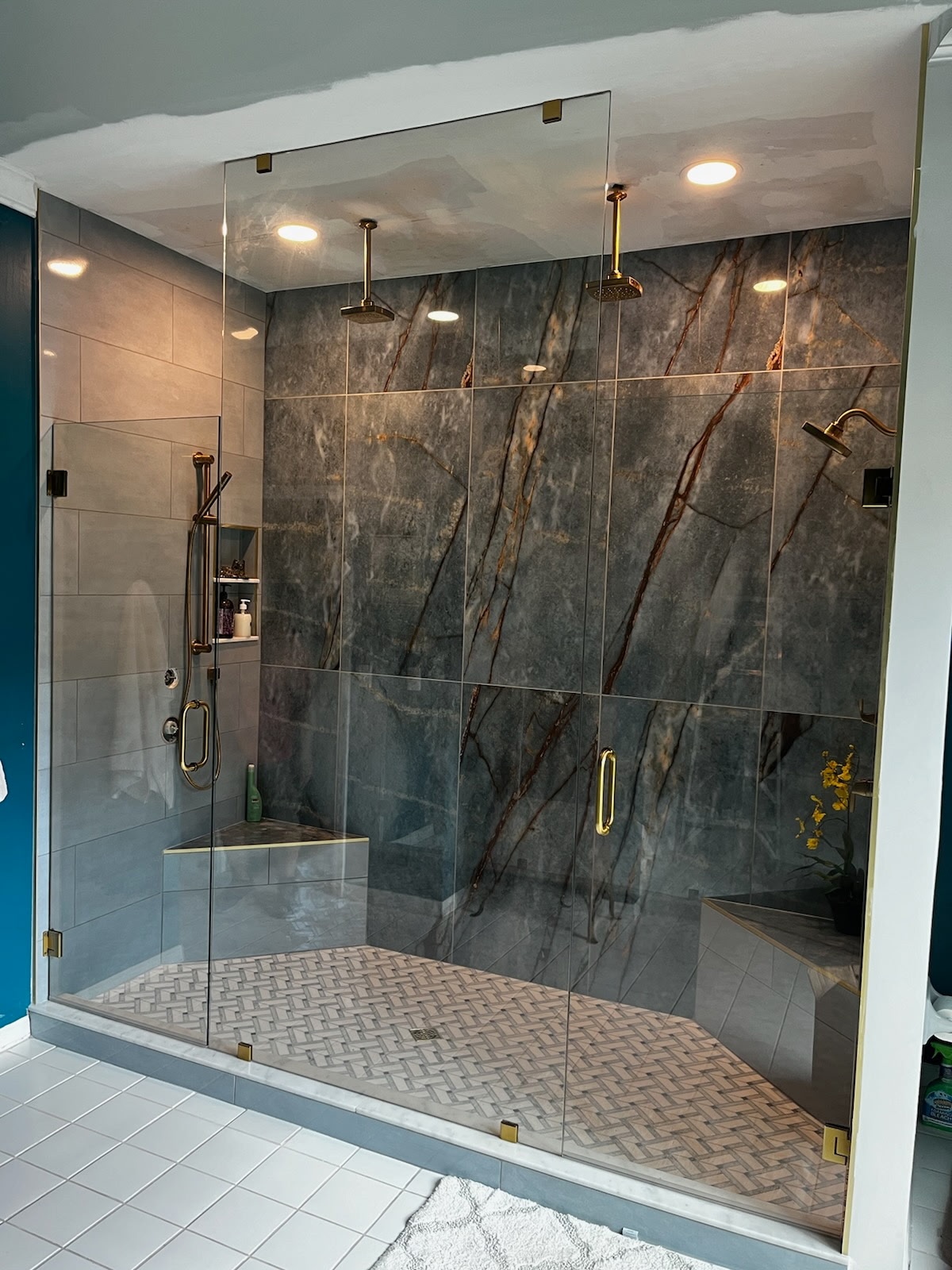
The safest, lowest-maintenance bathroom tile is chosen for two things: how much grip it has where water pools, and how little it absorbs so hard water can't stain it. In Tucson both questions have specific answers, because the slip standard sets a higher bar for a shower floor than for the rest of the bathroom, and the city's very hard water punishes a porous tile or the wrong grout. Get the slip rating and the porosity right, and the floor stays safe and easy to clean for years.
What Makes Bathroom Tile Safe Underfoot When It's Wet?
A tile's grip when wet is measured by its DCOF, short for dynamic coefficient of friction, a number the tile industry set through ANSI A326.3, the American standard for testing how slip-resistant a hard floor is under water. The test drags a weighted rubber foot across a wetted tile and records how much friction it holds, and a higher number means more grip. For a level interior floor that gets wet, ANSI A326.3 puts the minimum at 0.42, and any tile a manufacturer rates for wet floors publishes a DCOF at or above it. One caveat the standard states plainly: the number compares surfaces and does not promise that no one will ever slip, so treat 0.42 as a bar to clear rather than a guarantee.
Why a Shower Floor Needs a Higher Slip Rating Than the Rest of the Bathroom
A shower floor is held to a higher slip number than the bathroom floor outside it, because you stand on it barefoot and soapy. The 2022 revision of ANSI A326.3 split the old single threshold into five, and a wet-plus barefoot area like a shower pan now calls for a DCOF of 0.50, above the 0.42 that covers an ordinary wet floor. Outdoor tile, on a covered patio off the bath, climbs again to 0.55. So a tile that's perfect for the main bathroom floor can be too slick for the shower pan, and picking one tile for both is the most common tile mistake we see in a bathroom.
Why Shower Floors Use Smaller Tile
Shower floors use smaller tile because the grout lines between the pieces add grip and let the floor slope to the drain. A large tile is nearly flat and gives a wet foot few seams to catch; a small mosaic has grout lines every few inches, and that grid is what keeps you steady on a soapy surface. Small tiles also flex around the slope a shower pan needs to drain, which a big rigid tile can't do without lippage, the uneven ridge where one tile sits proud of its neighbor. The trade-off is more grout to keep clean, which is exactly where the grout choice earns its keep.
Porcelain, Ceramic, or Stone in a Wet Bathroom?
Porcelain is the safest default for a wet Tucson bathroom because it barely absorbs water. ANSI A137.1, the ceramic tile standard, defines porcelain as tile that takes in 0.5 percent or less of its weight in water, while softer ceramic classes absorb from 0.5 up to 7 percent. Natural stone is a different story: granite runs about 0.4 to 1.5 percent, but travertine and limestone commonly absorb 3 to 12 percent, so they soak up water and the minerals in it unless they're sealed and kept sealed. Stone can be beautiful in a bathroom, and plenty of Tucson homes have it, but in a shower it's a commitment to a sealing schedule that porcelain never asks for. Whatever you choose has to be set with full mortar coverage in a wet area, at least 95 percent under ANSI A108.5 against 80 percent in a dry room, so water can't work into a void behind it. You can weigh porcelain against the stone options in our tile and natural stone selections.
Grout, Hard Water, and What Keeps a Shower Looking Clean
Grout, more than the tile, decides whether a Tucson shower still looks clean years down the line. The U.S. Geological Survey classifies water above 180 milligrams per liter of calcium carbonate as very hard, and its study of the Tucson basin found the groundwater is hard, a mineral-heavy calcium bicarbonate water pulled through desert limestone. That water leaves scale and darkens porous cement grout quickly. Cement grout has to be sealed and resealed to fight it; epoxy grout costs more and is fussier to install, but it's essentially nonporous, so it resists staining and hard-water buildup with no sealer at all. On Tucson water, epoxy grout in a shower is often worth the upcharge, and where cement grout is used, sealing it on schedule is not optional.
Bathroom Tile by Location, at a Glance
Where it goes | Wet slip target (DCOF) | Tile that fits | Upkeep |
Shower floor | 0.50 or higher | Small porcelain or mosaic, more grout lines | Epoxy grout, or seal cement grout on schedule |
Shower and tub walls | Not a walking surface | Large porcelain, glass accents | Squeegee to limit scale |
Main bathroom floor | 0.42 or higher | Textured porcelain | Easy; damp mop |
Covered patio off the bath | 0.55 or higher | Textured porcelain | Sweep grit; reseal if stone |
Questions Tucson Homeowners Ask About Shower and Bathroom Tile
What DCOF should shower floor tile have in Tucson?
Aim for a wet DCOF of 0.50 or higher on a shower floor. That's the level ANSI A326.3 sets for a wet-plus barefoot area, above the 0.42 minimum for a regular wet bathroom floor, and it's the number to find on the tile's spec sheet before you fall for the look.
Is porcelain or natural stone better for a shower?
Porcelain is the lower-maintenance choice for a shower. It absorbs 0.5 percent or less of its weight in water under ANSI A137.1, so it never needs sealing, while travertine or limestone can absorb several times that and needs regular sealing to survive hard water. Stone is a fine choice if you want the look and will keep it sealed.
What is the best grout for a Tucson shower?
Epoxy grout holds up best against Tucson's hard water because it's nonporous and doesn't absorb minerals or stain the way cement grout does. Cement grout works too, but only if it's sealed and resealed on schedule; skip that and the grout lines darken and hold scale.
Can I use large tile on a shower floor?
Large tile belongs on shower walls rather than the shower floor. A shower pan has to slope to the drain, and small tiles with more grout lines both bend around that slope and give bare feet more grip, so large formats are better saved for the walls where slope and slip don't apply.
Designing a Bathroom That's Safe and Easy to Live With
The right bathroom tile is a match between where each tile goes and what that spot demands: grip on the shower floor, low porosity everywhere it gets wet, and grout that can take Tucson water. We help homeowners make those calls and remodel the bathrooms to match, and our mobile showroom can bring slip-rated samples to your home so you can feel the surface before you commit. Look through finished projects in our gallery, then request a free estimate and we'll walk your bathroom, talk through the tile and grout, and put a plan together.


