

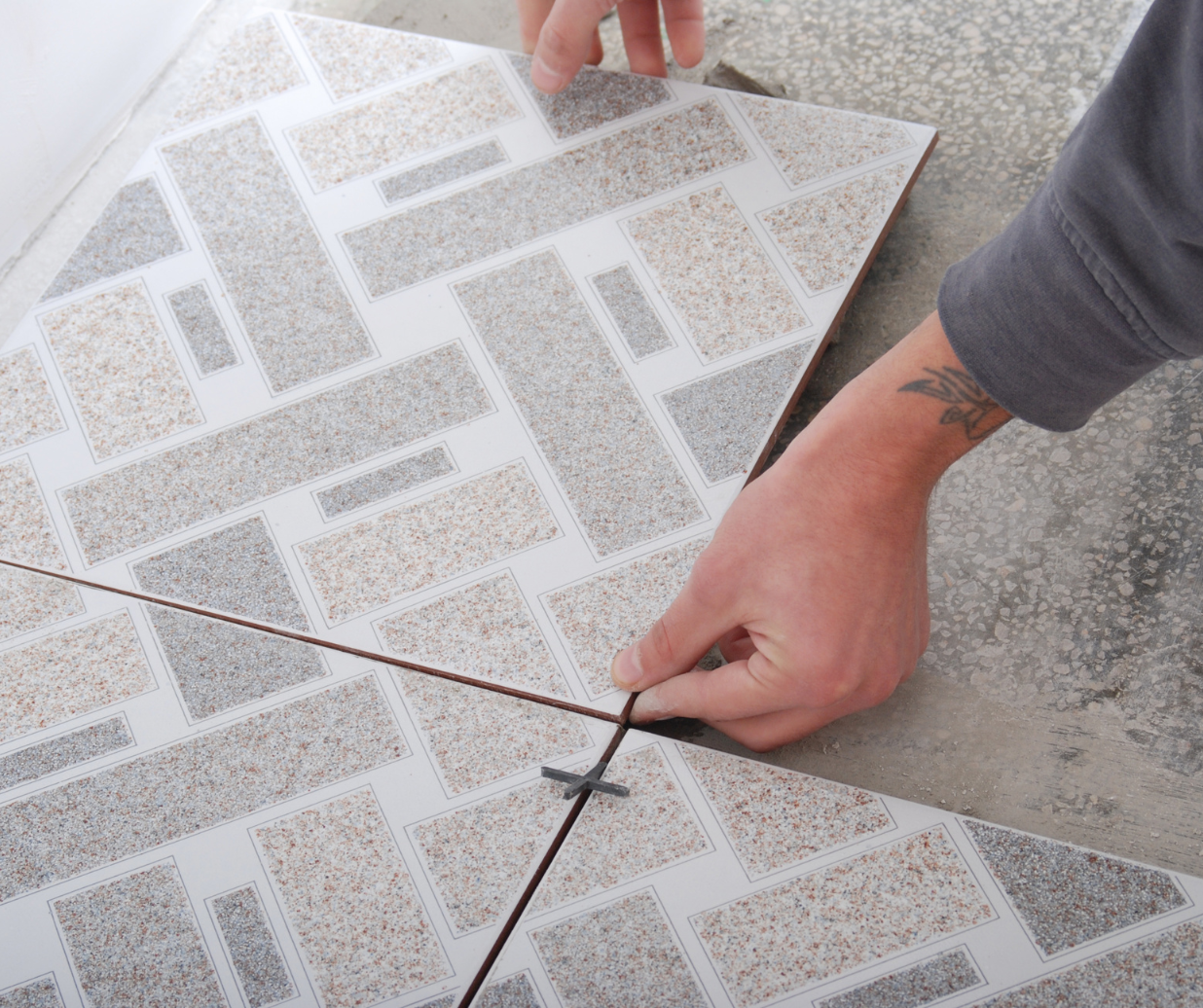
The price of a tile installation in Tucson is set more by the concrete slab under the floor, the tile format you pick, and the setting standards a crew has to meet than by the tile itself. Two installers can walk the same room and quote it hundreds of dollars apart, and most of that gap comes down to prep work. Knowing what drives the number is how you read an estimate instead of just reacting to it.
Why Two Tile Quotes for the Same Room Come Back So Different
A tile quote is really a bid on labor, and labor is set by the condition of what is already there. A finished tile floor is a system that starts at the slab and ends at the surface you walk on, and most of the price lives in the middle layers you never see: leveling the substrate, isolating cracks, and getting full mortar contact under every tile. One installer plans for all of it and prices it. Another leaves it out to win the bid, and you pay the difference later when the floor telegraphs every crack in the slab. Same tile, two very different floors.
The Slab Under Your Floor Is the Biggest Variable
In Southern Arizona, the concrete slab is the single biggest thing that moves a tile quote, because almost every home here sits on one and that slab is always moving. Concrete swells in triple-digit summer heat, shrinks on cool desert mornings, and develops hairline cracks as it ages. Tile bonded straight onto a moving, uneven slab cracks along the same lines. So a real quote covers whatever the slab needs: grinding down high spots, filling low ones with a self-leveling compound, and often a crack isolation membrane, a flexible layer that lets the tile float over small slab movements instead of copying them. A slab in good shape needs little of this and barely moves the quote. A cracked or wavy one needs a lot, and that prep is exactly where two quotes split apart. We broke down how the slab, underlayment, and setting bed work together in a separate piece on what actually goes under a durable tile floor.
How the Tile You Pick Changes the Labor Bill
The tile itself moves labor three ways: how hard it is to cut, how big it is, and how much its layout wastes. Porcelain is defined under ANSI A137.1 — the ceramic tile standard written by the Tile Council of North America, the U.S. industry body whose committees classify tile — as tile that absorbs 0.5 percent or less of its weight in water.
That density is what makes porcelain so hard-wearing, and it's also what makes it slow to cut: a crew goes through more blades and more minutes per cut than it would on a softer ceramic. Non-porcelain ceramic can absorb anywhere from 0.5 up to 7 percent of its weight under the same ANSI A137.1 classes, which is why it cuts faster but belongs in lighter-duty spots.
Denser tile + more cutting time = higher labor costs
Size is the bigger lever. Large-format tile, meaning any piece with a side longer than 15 inches, looks smooth and continuous because it has fewer grout lines, but it demands a much flatter floor to lie without lippage, the ridge you feel underfoot where one tile sits higher than its neighbor. Flatness standards let a standard tile floor vary by 1/4 inch over 10 feet; large-format tile cuts that to 1/8 inch over 10 feet, and 1/16 inch over any 2 feet. Meeting the tighter number usually means an extra round of grinding and self-leveler before a single tile goes down, which is real time on the clock. You can compare the formats and finishes in our tile selection before you weigh what each one takes to install.
Layout is the quiet one. A diagonal or herringbone pattern, a room full of angles, or a big tile that has to be cut around cabinets and thresholds all raise the number of cuts and the tile lost to waste. A simple grid in a square room is the cheapest thing to install; the same tile in a busy layout costs more in both labor and material.
What the Setting Standards Require, and Why It Costs Labor
A correct install has to meet mortar-coverage rules that a rushed one skips, and those rules are labor. ANSI A108.5, the standard for how tile is bonded down, calls for mortar to contact at least 80 percent of the back of each tile in a dry interior room, and 95 percent in a wet area, a shower, or outdoors, with full support under every corner.
Reaching 95 percent almost always means back-buttering, spreading mortar on the back of each tile as well as on the floor, which roughly doubles the setting time on those pieces. Natural stone raises the bar again: 95 percent coverage in dry and wet areas both, with no gap larger than 2 square inches and none within 2 inches of a corner, because an unsupported void under stone becomes a crack you can't fix without pulling the piece. That extra care is part of why a floor from our natural stone selection is quoted higher than a porcelain one of the same size.
The Line Items People Forget
The parts of a tile quote that surprise people are usually the ones with nothing to do with tile: tearing out and hauling away the old floor, moving furniture and appliances, and building the transitions where tile meets carpet, wood, or a doorway. Old floors don't come up for free. The thick mortar beds and Saltillo tile in older Tucson homes can take longer to demolish than the new tile takes to lay, and the debris still has to be hauled and dumped. Wet areas add waterproofing and the code-required water test before any tile goes on. None of this shows up on a tile sample tag, and all of it is real hours.
Why the Low Bid Can Cost You More
The low bid can cost you more because it usually leaves out both the prep and the license a real install includes. Arizona law says a contractor has to be licensed through the Arizona Registrar of Contractors, the state agency that licenses and regulates the building trades, once a job's labor and materials pass 1,000 dollars or once it needs a permit, and the law won't let anyone split one project into smaller invoices to stay under that line. A full-room tile floor clears 1,000 dollars easily, so an unlicensed bid for real tile work sits outside that exemption; it's someone operating without the accountability that gives you any recourse if the floor fails.
Our own installers are licensed and set tile to these standards every week, which is the difference between a floor that lasts and one that gets redone. The way those upfront savings evaporate is the whole subject of our piece on the hidden costs of hiring an unlicensed installer.
Tile Installation Cost FAQ's
Why is porcelain tile more expensive to install than ceramic tile?
Porcelain costs more to install because it is denser and harder to cut. The same 0.5 percent water-absorption limit that earns a tile the porcelain label under ANSI A137.1 wears through diamond blades faster and adds time to every cut, so labor climbs even when the tile price is close.
Does large format tile really cost more to install?
Yes, mostly because of floor prep. Large-format tile has to sit on a substrate flat to 1/8 inch over 10 feet, tighter than the 1/4 inch a standard tile allows, so the crew usually spends extra time grinding and pouring self-leveler before setting the first piece.
Do I need a permit to retile a floor in Tucson?
A straightforward floor retile is generally treated as finish work, but the moment the job touches plumbing or electrical, such as a shower rebuild or a moved drain, the City of Tucson needs a trade permit pulled for it, and any permitted job in Arizona has to be done by a licensed contractor. When you are not sure which side of that line your project falls on, check with the city before work starts.
How do I get an accurate tile installation quote?
The only accurate number comes from someone measuring your actual floor and checking the slab, because that's where the real variables live. A good estimate accounts for the tear-out, the prep the slab needs, the tile format, and any wet areas, and then puts all of it in writing before work begins.
Getting a Real Number for Your Tucson Floor
The honest way to price a tile floor is to have someone look at the slab, measure the rooms, and price the prep alongside the tile. We do that in person, and our mobile showroom can bring samples to your home so you can match the tile to the room while we talk through what is underneath it. When you are ready to see real numbers, request a free estimate and we will measure, check the slab, and walk you through the options; if budget is the sticking point, we also offer project financing so the prep a floor actually needs does not get cut to hit a number.


